

mindec cover image sample
Created 10/23/2026Edited 10/23/2026
- cover-image
- mindec.dev
1 view

Source: Instagram (opens in a new tab)
Contents (18)
This archive systematically organizes high-resolution astronomical and planetary exploration imagery collected from official NASA research channels, including the official NASA Instagram account (@nasa), NASA Science, Astronomy Picture of the Day (APOD), and the James Webb Space Telescope science portal. It encompasses deep-space nebulae, star-forming regions, galaxy clusters, interacting galaxies, Solar System exploration missions, and orbital Earth observations.
- InstagramSource 1, NASAMaking the seemingly impossible, possible. ✨
- NASA ScienceSource 2, NASA’s Webb Takes Star-Filled Portrait of Pillars of Creation - NASA ScienceEditor’s Note, Oct. 21, 2022: The story below has been updated to clarify what is visible in the James Webb Space Telescope’s Pillars of Creation NIRCam
- NASA ScienceSource 3, “Cosmic Cliffs” in the Carina Nebula (NIRCam Image) - NASA ScienceWhat looks much like craggy mountains on a moonlit evening is actually the edge of a nearby, young, star-forming region NGC 3324 in the Carina Nebula. Captured in infrared light by the Near-Infrared Camera ( NIRCam ) on NASA’s James Webb Space Telescope, this image reveals...
1. Deep-Space Nebulae and Star-Forming Regions
Blue Gas and X-ray Emission in the Lagoon Nebula (Messier 8)

Blue gas, dust clouds, and Chandra X-ray composite observation of the Lagoon Nebula (Messier 8)
Source: Instagram- Celestial object: The featured target is the Lagoon Nebula, cataloged as Messier 8.
- Observational features: Massive young stars are vigorously forming within dense interstellar gas and dust clouds that resemble a deep blue sea.
- Data composite: Energetic radiation from young stars is synthesized with X-ray data gathered by the Chandra X-ray Observatory (@nasachandraxray), highlighted in bright pink hues.
Butterfly-Shaped Planetary Nebula NGC 2899

Hubble Space Telescope observation of the butterfly-shaped planetary nebula NGC 2899
Source: Instagram- Celestial object: The featured target is the planetary nebula NGC 2899.
- Observational features: The nebula exhibits a symmetric, butterfly-like structure with two wide expanding lobes.
- Formation mechanism: Powerful stellar winds and interactions from stars located at the center expelled gaseous material in opposite bipolar directions, creating this symmetric winged formation.
Stellar Nursery NGC 7129 Revealed by the James Webb Space Telescope

James Webb Space Telescope infrared observation of the young stellar nursery NGC 7129
Source: Instagram- Celestial object: The image captures the star-forming region NGC 7129.
- Significance of infrared astronomy: Because newborn stars form inside cold, dense veils of gas and dust, optical telescopes cannot penetrate their birthplaces. The infrared sensitivity of the James Webb Space Telescope pierces through these obscuring dust sheets to reveal fine internal structures.
- Structural details: A luminous central star with approximately five to eight times the mass of the Sun is clearing out a golden cavity on the left side with its radiation. The red glowing zone on the right contains embedded protostars that are accreting surrounding matter and launching high-velocity outflows.
Sagittarius B2 Region at the Galactic Center
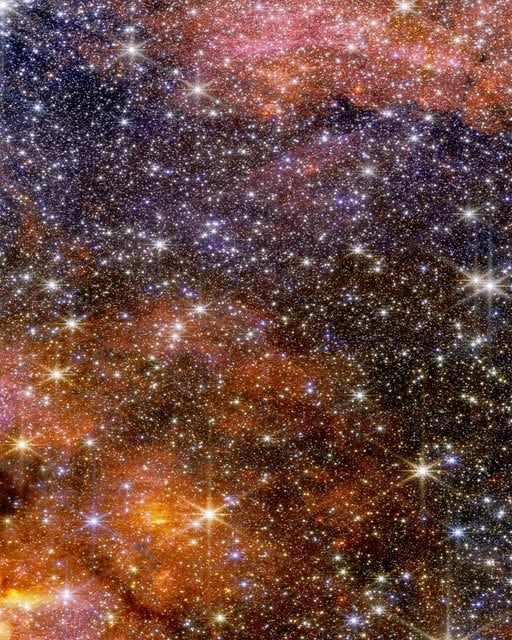
James Webb Space Telescope observation of the Sagittarius B2 star-forming complex near the center of the Milky Way
Source: Instagram- Celestial object: The observation focuses on Sagittarius B2, located near the center of the Milky Way.
- Key characteristics: This complex is one of the most massive and active star-forming regions across the entire galaxy, giving birth to nearly half of all stars currently forming in the Galactic Center.
- Observational value: The James Webb Space Telescope penetrates deep into the high-density molecular clouds of the Galactic Center to reveal countless embedded stars.
'Pillars of Creation' in the Eagle Nebula (M16)
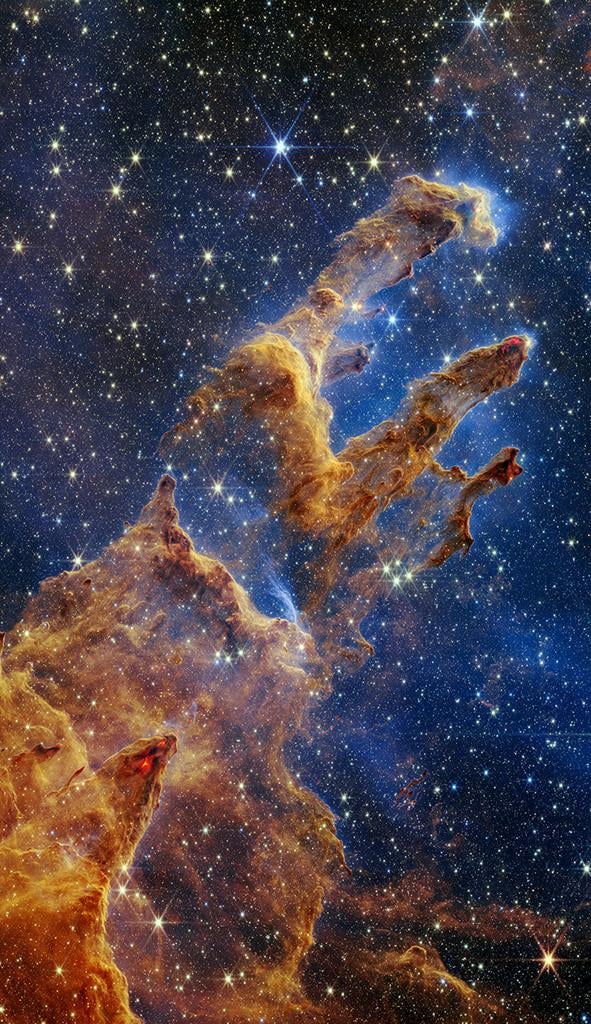
James Webb Space Telescope NIRCam high-definition portrait of the Pillars of Creation in the Eagle Nebula
Source: NASA Science- Celestial target and location: The image displays the Pillars of Creation within the Eagle Nebula (Messier 16), located approximately 6,500 light-years from Earth.
- Observing instrument: The portrait was acquired using the Near-Infrared Camera (NIRCam) aboard the James Webb Space Telescope.
- Physical processes: Three-dimensional pillars of cold interstellar gas and dust appear semi-transparent in near-infrared wavelengths. Bright red points near the column tips are newly formed protostars collapsing under their own gravity, while undulating ruby edges represent bow shocks created when supersonic stellar jets collide with surrounding material.
'Cosmic Cliffs' in the Carina Nebula (NGC 3324)
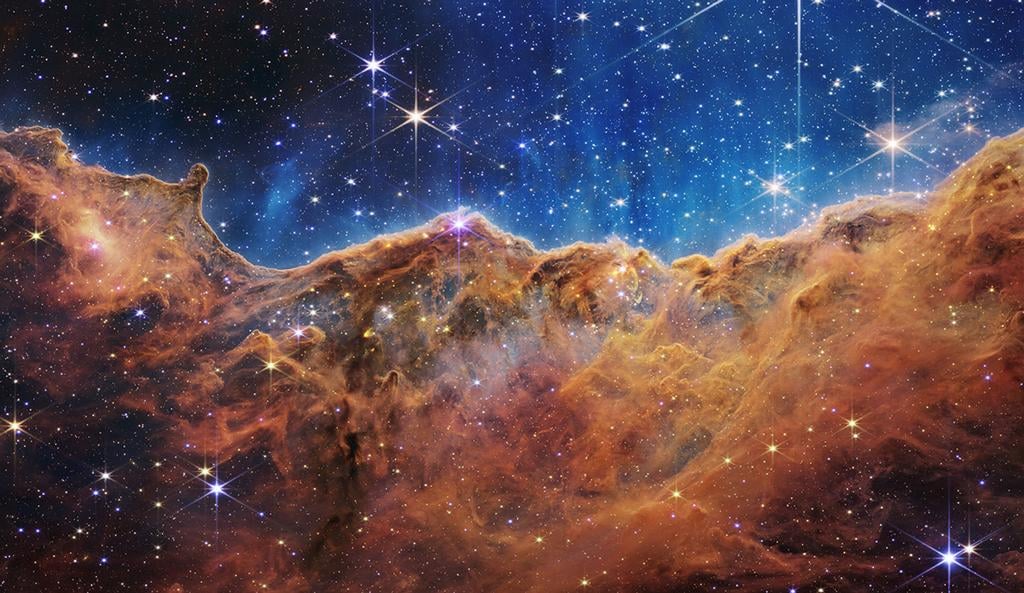
James Webb Space Telescope portrait of the Cosmic Cliffs star-forming region in NGC 3324 of the Carina Nebula
Source: NASA Science- Target and location: The structure is located in the star-forming cluster NGC 3324 at the northwest edge of the Carina Nebula, situated roughly 7,600 light-years away.
- Observational features: Resembling craggy mountains on a moonlit night, this dramatic boundary is known as the Cosmic Cliffs and marks the edge of a gigantic gaseous cavity.
- Sculpting mechanism: Blistering ultraviolet radiation and intense stellar winds from massive, hot young stars located above the frame continuously carve and erode the cavernous wall of gas.
- InstagramSource 1, NASAMaking the seemingly impossible, possible. ✨
- InstagramSource 4, nasawebb on Instagram
- InstagramSource 5, nasa on Instagram
- NASA ScienceSource 2, NASA’s Webb Takes Star-Filled Portrait of Pillars of Creation - NASA ScienceEditor’s Note, Oct. 21, 2022: The story below has been updated to clarify what is visible in the James Webb Space Telescope’s Pillars of Creation NIRCam
- NASA ScienceSource 3, “Cosmic Cliffs” in the Carina Nebula (NIRCam Image) - NASA ScienceWhat looks much like craggy mountains on a moonlit evening is actually the edge of a nearby, young, star-forming region NGC 3324 in the Carina Nebula. Captured in infrared light by the Near-Infrared Camera ( NIRCam ) on NASA’s James Webb Space Telescope, this image reveals...
2. Galaxy Clusters and Interacting Galaxies
Distant Galaxies Warped by Gravitational Lensing

Background orange galaxies warped into arcs by the strong gravitational lensing of a foreground galaxy cluster
Source: Instagram- Visual distortion and physical principles: The immense gravitational field of luminous foreground galaxies curves the fabric of space-time, bending and magnifying the light of distant background orange galaxies into elongated arcs.
- Scientific significance: Predicted by Albert Einstein's general theory of relativity, gravitational lensing transforms massive galaxy clusters into cosmic magnifying glasses that enable astronomers to study the earliest and most distant galaxies in the universe.
The Rose-Like Interacting Galaxy Pair Arp 273 (UGC 1810)

Hubble Space Telescope portrait of the interacting galaxy pair Arp 273 featured as NASA Astronomy Picture of the Day
Source: NASA Science- Target and location: The system comprises the spiral galaxy UGC 1810 and its smaller companion within the Arp 273 group, positioned approximately 300 million light-years away in the constellation Andromeda.
- Source and selection: The portrait was captured by the Hubble Space Telescope and featured as the NASA Astronomy Picture of the Day (APOD).
- Gravitational interaction: Violent gravitational tidal forces from the companion galaxy distorted the outer spiral arms of UGC 1810 into a rose-like ring. The vivid blue ring glows from intense bursts of massive, hot young stars that formed within the past several million years.
- InstagramSource 6, nasa on Instagram
3. Solar System Planets and Deep-Space Exploration
Auroras and Atmospheric Hazes of Jupiter Captured by Webb

James Webb Space Telescope infrared observation showing Jupiter's polar auroras, Great Red Spot, and high-altitude hazes
Source: NASA Science- Target and instrument: The observation highlights Jupiter, the largest gas giant in the Solar System, imaged by the Near-Infrared Camera (NIRCam) on the James Webb Space Telescope.
- Atmospheric details: Luminous cyan auroras glow above both the northern and southern poles alongside high-altitude stratospheric hazes. The Great Red Spot, a storm larger than Earth, appears bright white because its high clouds reflect substantial amounts of sunlight.
- Data processing: The infrared wavelengths were mapped into visible colors through a collaborative image processing effort with citizen scientist Judy Schmidt.
Jezero Crater on Mars and the Perseverance Rover

Conceptual illustration of the NASA Perseverance rover exploring the rocky terrain of Jezero Crater on Mars
Source: NASA Science- Exploration mission: The portrait depicts the NASA Mars 2020 mission featuring the Perseverance rover.
- Exploration site: The rover investigates Jezero Crater, an ancient lakebed and preserved river delta with high potential for past habitability.
- Mission milestones: Perseverance has operated for more than 2,000 Martian sols, setting an extraterrestrial driving record of 28.1 miles (approximately 45.2 km). The rover continues to collect and seal crucial rock core samples to search for ancient biosignatures.
- NASA ScienceSource 8, Webb’s Jupiter Images Showcase Auroras, Hazes - NASA ScienceWith giant storms, powerful winds, auroras, and extreme temperature and pressure conditions, Jupiter has a lot going on. Now, NASA's James Webb Space Telescope has captured new images of the planet. Webb's Jupiter observations will give scientists even more clues to Jupiter's inner life. "We hadn't really expected it to be this good, to be …
- InstagramSource 1, NASAMaking the seemingly impossible, possible. ✨
4. Spacecraft Launches and Earth Observation
SpaceX CRS-35 Launch and the 'Space Jellyfish' Phenomenon

Space twilight plume forming a space jellyfish during the pre-dawn launch of SpaceX CRS-35
Source: Instagram- Mission profile: The SpaceX CRS-35 cargo mission launched in the pre-dawn hours of October 13, 2026, to resupply the International Space Station (ISS).
- Atmospheric mechanism: While the launch pad remains in darkness before sunrise, high-altitude rocket exhaust plumes are illuminated directly by sunlight, producing an ethereal, glowing jellyfish-shaped nebula in the twilight sky.
Night Lights of Central Asia and Auroras from the Space Station

Long-exposure photograph from the International Space Station showing Central Asian city lights and atmospheric auroras
Source: Instagram- Photographic context: Astronaut Anil Menon captured this long-exposure view on September 9, 2026, while orbiting aboard the International Space Station (ISS).
- Visual elements: Bright light trails from major urban centers in Central Asia streak across the surface, while a vibrant green auroral curtain arcs along the upper atmospheric horizon.
The Illuminated Nile River Valley and Cairo by Night
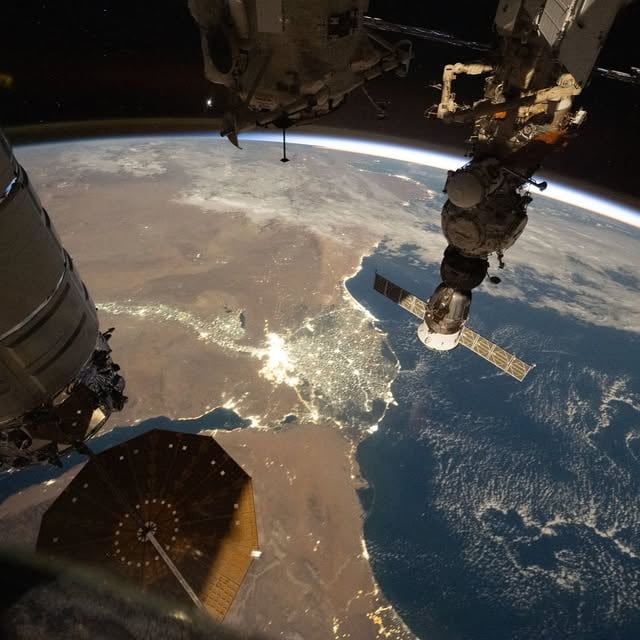
Nighttime view of the illuminated Nile River Delta and Cairo captured from the International Space Station
Source: Instagram- Orbital vantage point: The photograph was taken from aboard the International Space Station (ISS) looking down on northeastern Africa.
- Visual characteristics: Amidst complete surrounding darkness, human settlements along the ribbon of the Nile River and the expansive Nile Delta glow like an intricate neural network.
The Weathered Spider Crater in Western Australia

Satellite observation of the ancient and eroded Spider Impact Crater in Western Australia
Source: Instagram- Geological landform: The satellite image shows Spider Crater, an ancient meteorite impact structure in Western Australia.
- Geological evolution: Following a meteorite impact hundreds of millions of years ago, prolonged weathering and erosion stripped away softer strata, leaving prominent spider-leg-like sandstone ridges radiating across the terrain.
- InstagramSource 1, NASAMaking the seemingly impossible, possible. ✨
- InstagramSource 9, nasa on Instagram
- InstagramSource 10, nasa on Instagram